Accessories

Hubble 5-Star Artificial Stars

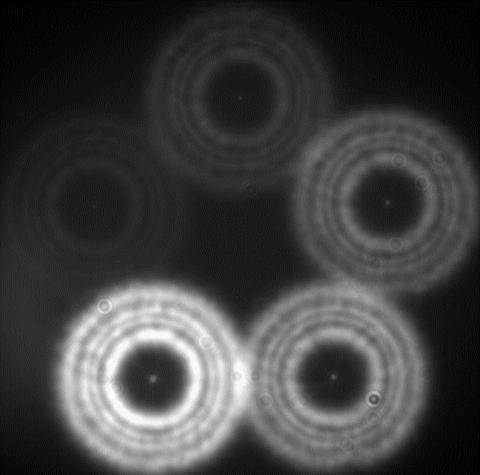
Star-test and collimate your telescope anytime, anywhere. Five precision pinholes (50/100/150/200/250 microns) let you instantly find the best star for your particular telescope at any distance and lighting environment.

$27-$32 USD

The Problem

To accurately test and collimate reflectors, catadioptric telescopes, and refractors, you must perform a star test. Sadly, a real star is not always available due to poor weather conditions or location. Even when a star is available, you need a good tracking system because the star is always moving. Air turbulence may affect your test, and the real star may not reveal the true quality of your telescope or give you a perfect collimation. Traditional artificial stars require many different sizes for different telescopes of different apertures and focal ratios, different distances, and different lighting environments.

The Solution

The innovative Hubble 5-Star Artificial Star has 5 bright white LEDs with 5 precision pinholes (50/100/150/200/250 microns), enabling accurate star testing across virtually all telescope types — from small refractors to fast, large-aperture Newtonians — when paired with the appropriate pinhole and setup distance. The multi-star design also lets you compare pinhole sizes side-by-side and adapt quickly when your available distance isn't ideal. Simply choose the smallest star that gives a clear defocused image, then mask out any 4 of the 5 stars with the provided magnetic mask. Works in any lighting condition, day or night.

Distance Scales with Aperture

The artificial star must be placed far enough away that the pinhole appears smaller than your telescope's Airy disk. Larger apertures need significantly more distance — a 4" refractor works at just a few meters indoors, while a 20" telescope typically needs tens of meters for basic collimation and 50 meters or more for a clean, high-quality star test (especially on fast f/3–f/4 systems). If in doubt, start far and move closer until the defocused image is clean but still bright.

Smaller Than the Airy Disk

For a valid star test, the pinhole must appear as an unresolved point — smaller than your telescope's Airy disk. If the pinhole is resolvable, you're imaging a disc instead of a point source, and the diffraction pattern will not be clean. This is exactly why fast, large-aperture systems (f/3 – f/4) need the tightest 50-micron pinhole: a single commercial 50-micron laser-drilled hole typically runs $40+ on its own.

Pick the Right Pinhole, Mask the Rest

Start with the smallest pinhole that gives a clear defocused image, then use the magnetic mask to isolate it by covering the other four. Fast or large apertures usually need 50 microns; slower or smaller scopes can use a brighter 150–250 micron star at shorter distances.

Batteries & Care

Powered by 3 AAA batteries (not included). Insert batteries and switch on. Keep the mask clean and use only when needed to prevent blockage of the pinholes. Store in a Ziploc bag when not in use, separated from the magnetic mask. There are no printed instructions in the package.

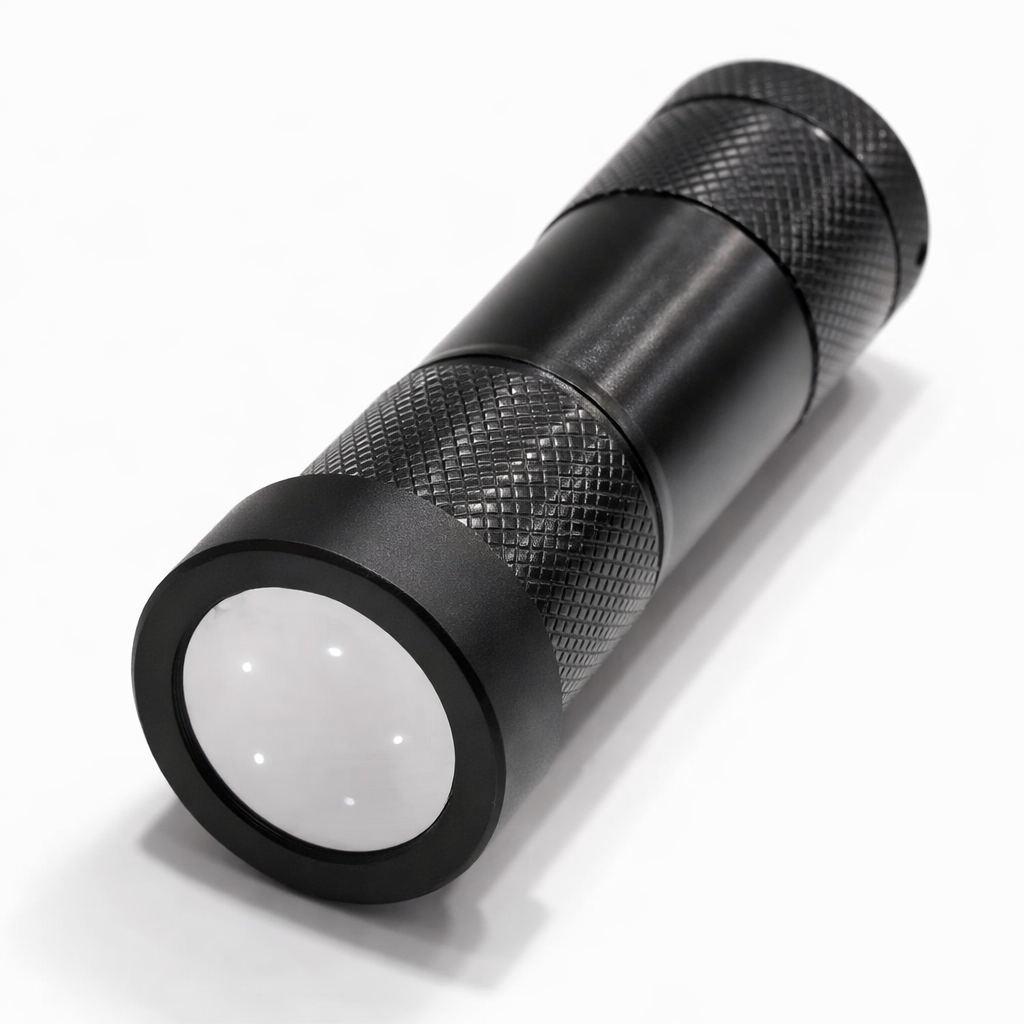
Hubble 5-star artificial stars with magnetic mask Hubble 5-star artificial star close-up view Hubble 5-star artificial star with pinholes illuminated Hubble 5-star artificial star product packaging

Recommended Books

Star Testing Astronomical Telescopes, Second Edition by Harold Richard Suiter — a must-have reference.
Build Your Own Telescope by Richard Berry — includes an excellent chapter on the star test.

Technical Documentation

For the full set of setup physics, aperture-vs-distance calculations, and additional test notes:
Detailed Setup & Theory Guide (PDF)

"This little thing is fabulous value for the few dollars you are charging. I've been contemplating various other types of artificial star gadgets, but, they all seemed so expensive. This little guy is simplicity in itself, and does the job fabulously. Extremely good value at the price you are selling it for."

"My SCT was collimated better than it's ever been that night, and, I did the collimation in broad daylight."

"The best $20 astronomical investment I have ever made."

"I measured the holes using a scanning electron microscope at work... The microscope can reliably measure down to less than 10 nanometers (0.01 micrometers). Considering a single 50 micron laser drilled hole in stainless steel disc (unmounted and no LEDs) can run $40-50 from commercial suppliers here in the US, this is a fantastic bargain!"

"Your 5-Star Artificial Star is GREAT! I've never had an easier time collimating my SCT. Thanks for a great product."

"It's the best astro tool that I ever bought... In my opinion, it looked much better than a real star."

"Achieved the best collimation I have had in a long time..."

"Great product, good price! I wish I had bought this sooner!"

"Great little item! Collimation's a snap with this tool."

"Every telescope user should have one."

How far should I place the artificial star from my telescope?
Distance depends on your aperture and the pinhole size. The artificial star must appear smaller than your telescope's Airy disk — so larger apertures need longer distances. As a rough guide, a 4" refractor works indoors at a few meters; a 20" telescope needs tens of meters for basic collimation and 50 meters or more for a clean, high-quality star test with the 50-micron pinhole, especially on fast f/3–f/4 systems. If in doubt, start far and walk closer until the defocused image is clean but still bright.
Why five pinholes instead of one?
No single pinhole works for every telescope. Fast, large-aperture systems need a very small 50-micron source to stay unresolved, while smaller or slower scopes can use a brighter 150–250 micron star at shorter indoor distances. Rather than force you to guess, you get all five — pick the smallest that gives a clean defocused image, then use the magnetic mask to isolate it. A single 50-micron laser-drilled hole from a commercial supplier typically runs $40+ on its own.
Does it work with very fast telescopes (f/3 – f/4)?
Yes — and this is exactly where single-pinhole artificial stars often fail. Fast, large-aperture systems require an extremely small source (50 microns) to remain unresolved, and the distance needs to be long enough that the pinhole's angular size stays below the Airy disk. With the 50-micron pinhole placed at an appropriate distance, you can star-test and collimate fast Newtonians, Dobsonians, and large SCTs confidently.
Will it work for standard SCTs, refractors, and Dobsonians?
Yes. The 5-Star is a universal tool. Standard f/10 SCTs, f/6–f/8 refractors, and all Dobsonians collimate easily with one of the larger pinholes at modest indoor distances. Many customers use it for routine SCT collimation in a hallway or long room — in broad daylight if needed.
What batteries does it use?
Three AAA batteries (not included). Insert them and switch on.
How do I use the magnetic mask?
The magnetic mask isolates a single pinhole by covering the other four. Pick the pinhole that gives the cleanest defocused image in your telescope, then place the mask so only that hole is exposed. Keep the mask clean and stored separately when not in use.
Can I collimate indoors in daylight?
Yes. The bright white LEDs are visible in a well-lit room, and the magnetic mask keeps the single isolated pinhole bright enough against normal indoor lighting. This is one of the most popular uses of the 5-Star — collimation any time, in any weather.
Single Unit

$27-$32

Select your shipping destination. Estimated 6-10 business days delivery.

Two-Pack

$49.50-$54.50

Select your shipping destination. Estimated 6-10 business days delivery.

Replacement Magnetic Mask

$10

May be shipped in stamped mail with no tracking.