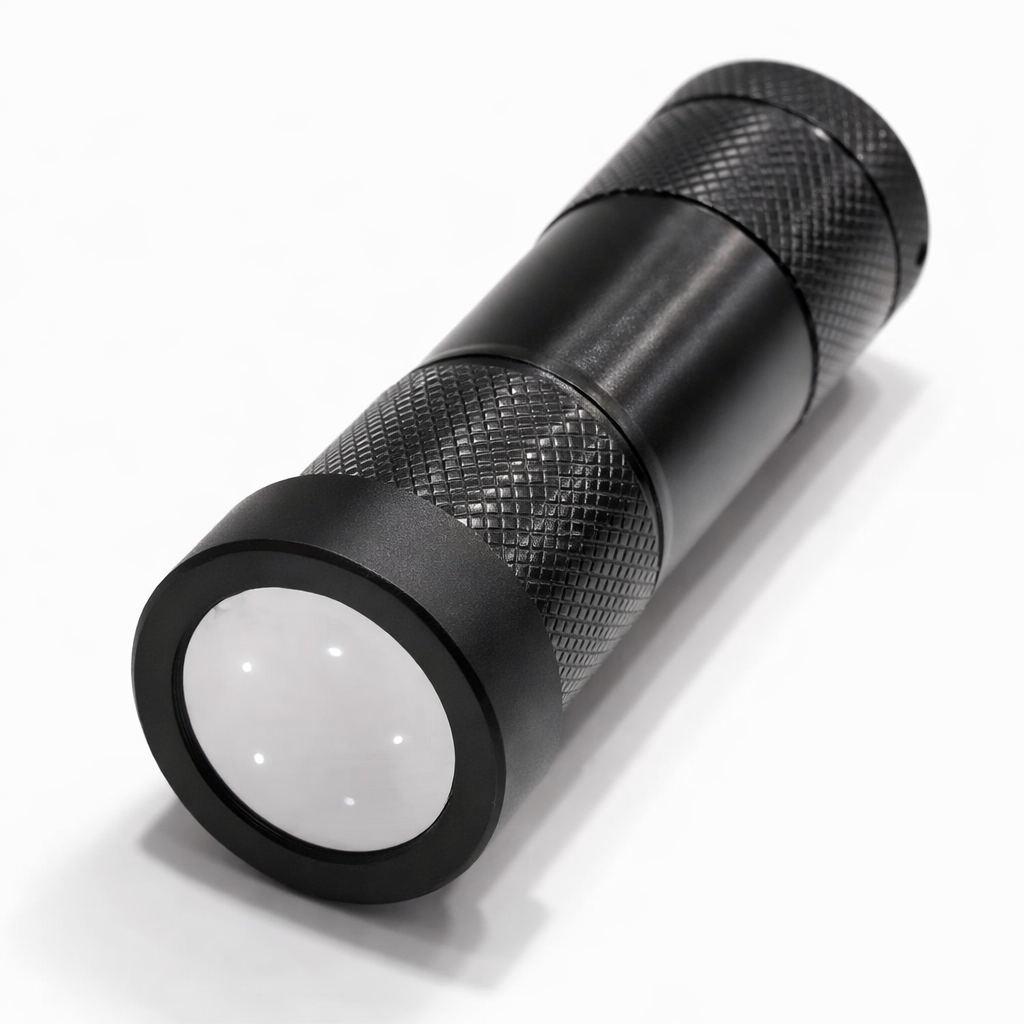
Hubble 5-star Artificial Stars
The star test is the ultimate method to test and collimate all kinds of your telescopes,
reflectors, catadioptric, and refractors. The most and very much the only difficult part of
doing the star test is that you need a star. Sadly, a real star is not always available, and you
really may not want to spend your precious observation time doing star test even when it is
available. Of course, you will also need a good tracking system for doing star test with the
moving star. After all the troubles, due to the turbulence, the real star may not even reveal
the true quality of your telescopes or give you a perfect collimation.
An artificial star will provide you an excellent alternative mean to do the star test anytime
and anywhere you want, without any of the drawbacks of the real stars. However, the
problem with the artificial star is that you really need different size of artificial stars for
different telescopes of different apertures with different F/#, and even for the same
telescopes but at different distances, and under different lighting environment.
The innovative Hubble 5-star Artificial Stars is a perfect solution to this problem. It has 5
bright white LEDs with 5 precision pinholes (50/100/150/200/250 microns). It will enable
you to test practically all telescopes of different apertures with different F/#, from any
reasonable distances needed, and under different lighting conditions.
- You can instantly find out which star is best for your particular telescope at that
particular distance under that particular lighting environment by simply choosing the
smallest possible star, but which still give you clear defocused image
- You can even adjust the brightness of the stars by twisting the LED cap.
- You can mask out any 4 of the 5 stars with a provided magnetic mask.
With Hubble 5-star Artificial Stars, telescopes are truly easy to test and collimate!
Special Introduction offers:
The single unit: $24.95 ($19.95 +$5 Shipped Worldwide)
(regular price $29.95)
The 2 unit pack: $46.40 (Shipped Worldwide)
(regular price $55.50)
Shipped via HKPS airmail, 6-10 business days delivery

Copyright 2009, All Rights Reserved
Q1: Is there a printed document for the Hubble 5-star Artificial Star(s)?
There is no printed document. But we will maintain this online FAQ up to date as a brief
document to the 5-star. Here is the printable version of this FAQ.
For complete and detailed instruction on the collimation and star test, please refer the
must have book by Harold Richard Suiter, Star Testing Astronomical Telescopes, Second
Edition
Q2: Where do you place the 5-star during the test?
The 5-star can just sit on a tripod top, on a table, or even on a rock; you only need to aim
the star roughly towards (no precision aiming required!) to your telescope; then aim your
telescope to the 5-star. The 5-star provides a very wide angle for a very easy usage.
Q3: Which of the 5 stars to use for the star test?
Choose the smallest possible star, but which still give you clear defocused image. You
may need to dim the stars with the new batteries by twisting the LED head cap. Basically
you change the brightness by adjusting the alignment among the LEDs and the pinholes.
It is time to change batteries if all stars are too dim to see clearly.
Q4: How far should the 5-star be placed from the telescope?
The 5-star should be placed in a distance to you scope about M times of the focal length of
FL; M is 336*D/F^3, or 336*D/(F*F*F) for a Newtonian(May, 1991, Sky and Telescope,
Roger Sinnott), where D is the Clear Aperture (in inches) and the F is the focal ratio. E.g., if
your scope is 10" F/5, then the M is 336 x 10 / 5^3 = 336 x 10 /(5 x 5 x 5) =26.88. So the 5-
star need to be M x FL = M x D x F = 26.88 x 10 x 5 = 1344" away, or about 34 m away. In
general, a minimum of 20 for the M is suggested by Suiter.
The above distance is for the real star test, for the collimation purpose; about 70% of
above distance is good enough.
As long as you have enough back focus to focus on the close by object, you will be
surprised how close you can get for the collimation. You may need to add one or two
focuser extension tubes.
Q5: How to perform the collimation with the 5-star?
First you should check if the scope is in rough collimation by observing a strongly
defocused star image (about 10 wavelets, or move focuser in or out until seeing about 5-
10 rings). All rings and shadows should be concentric; if not, please perform the
collimation according to the instruction of the telescope until all rings and shadows are
concentric. You should do this at a magnification of 25X of your scope’s diameter (in
inches).
Coma due to misalignment of a 10" F/8 scope:

Then you need to do a fine and final collimation by observing the focused 50 microns
star image, the famous Airy disk with a magnification of at least 50X of your scope’s
diameter (in inches). Use a 2X, or 3X Barlow lens if necessary. You should see an
uniform, complete, and concentric Airy disk and diffraction rings if the scope is in
perfect collimation. Follow the same procedure to do minor adjustment on your scope
until you reach a perfect collimation.
This is the final judgment of the collimation of your telescopes and all other
collimation tools and methods! Due to the seeing limit, you will be most likely unable
to do this with a real star! Actually with a real star, most likely you will be unable to
see the Airy disk at all!

Some excellent review articles on 5-star:
An Astromart Article by Greg Nowell
A Cloudy Nights Review Article by Bill Faatz
An Astronomy Technology Today Review Article by David Snay
Some feedbacks from our customers:
-Accurate description, useful item, recommended
-Smooth deal - perfect, as advertised merchandise
-Novel solution...
-Item as described (actually, even better), packed well, - thanks!
-Super Great Deal
-Recommended!
-Great product,low price,fast delivery.
-EVERYTHING AS EXPECTED. THANKS FROM GREECE!
-Nice Star and great communication - recommended
-JUST WHAT I WANTED
-Great company! Great product!
-Achieved the best collimation I have had in a long time...
-This is exactly what I have been looking for...
-** Best seller of all! ** Thanks for advice about Item handling!! Thanks a lot!!
-Thank you very much about your new Star-item. It works very well. I am so happy.
Clear skies to you and may your summer days be warm and full of sales!
-Works a treat! Great Astro bargain. Highly recommended. Very Fast delivery!!!
-Great product. Great price. Very happy with the transaction.
-Great company to deal with, nice product!
-great product --- quick delivery AAA +++
-This little thing is fabulous value for the few dollars you are charging. I've been
contemplating various other types of artificial star gadgets, but, they all seemed
so expensive. This little guy is simplicity in itself, and does the job fabulously.
Extremely good value at the price you are selling it for.
-Super device! Well made! Great price! FAST shipping!
-Todo perfecto.+++++++++EXCELENTE+++++++++++++++
-Great product... AMAZING CUSTOMER SERVICE!!!! Highly Recommended!
-The best $20 astronomical investment I have ever made.
-My SCT was collimated better than it's ever been that night, and, I did the
collimation in broad daylight.
-Wow, it really works, even at 86 ft. I just have to keep direct sunlight off the
artificial star so there's enough contrast to see the "airy disc" and you're good
to go. I can't wait to see it against the stars tonight, my scope was pretty
decently (and quite noticeably) out of collimation. Now I feel it's pretty darn spot
on.
-I first made sure the focuser was properly aligned. I then used a barlow laser to
make sure both secondary and primary were aligned. Then using the artificial star, I
tweaked the primary. I had to move two knobs each about 1/8th of a turn at most. I
then locked the mirror with the locking screws, and pointed up at Polaris. It was
pretty darn spot on…
I measured the holes of both (units) using a scanning electron microscope at
work... The microscope can reliably measure down to less than 10 nanometers
(0.01 micrometers). Considering a single 50 micron laser drilled hole in stainless
steel disc (unmounted and no LEDs) can run $40-50 from commercial suppliers
here in the US, this is a fantastic bargain! Thanks very much.
-Your 5-Star Artificial Star is GREAT! I've never had an easier time collimating my SCT.
Thanks for a great product.
Great product, good price! I wish I had bought this sooner!!
-IT WORKS!
I am wondering why I didn't get one of these long ago...
-My dad is very pleased with his birthday gift. Thanks.
Perfect
-Great Little item! Collimation's a snap with this tool.
Simply put ,you exceeded by far my biggest hopes.
-Very, very, very great tool. Should have had it years ago. Excellent a+
It's the best astro tool that I ever bought... In my opinion, it looked much better
than a real star.
Every telescope user should have one.
Q6: How to perform the star test with the 5-star?
Choose an appropriate star for your scope (Q2). After making sure the scope is in
perfect collimation(Q4), follow the normal Star Test procedure to perform the test.
Q7 After inserting the batteries, why the unit cannot be turned on?
Please make sure all cells are inserted in right direction, the spring to the negative.
Please re-insert all the cells if necessary to make sure all cells are in good contacts.
Try some new cells in necessary.
Q8: How was the Hubble Space Telescope tested once it had been launched into the
space?
The star test was used extensively and exclusively for the diagnosis and verification for
the Hubble Space Telescope in the space.
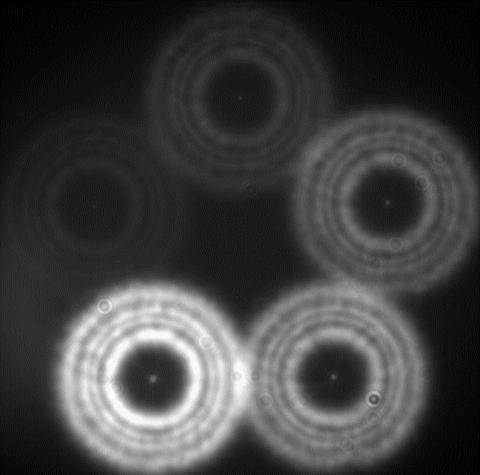
Referring to the last image attached (The imaging performance of the Hubble Space
Telescope, by C.J. Burrows et al, Astrophysical Journal, March, 1991), "The left two
columns (note that the first and third columns in the first two rows are not clear enough
to be visible) show observed images of bright stars at two different scales, while the
right columns show correspond models. The top two rows show images taken on each
side of the nominal focus position. These images clearly demonstrate the presence of
spherical aberration. Instead of a uniformly illuminated pupil image, the inner or outer
edges are brighter"

Here is a description (F. Roddier, C.Roddier, Appl. Opt. 32, 1993) on how the star
test was conducted on the Hubble Space Telescope (HST) , “we requested that the
highly defocused images be taken in flight by HST so that the method (the Roddier
method) could be applied to estimate the exact amount of spherical aberration.
Because defocusing the imaging also defocus the telescope tracking system, it
was not possible to obtain images sufficiently defocused for the method to apply.
However, defocused images recorded by the HST are not blurred by the
atmosphere and can be taken through narrow-band filter. In this case the wave-front
information is still preserved and can be recovered by using phase-retrieval
algorithm”
The following Star test images are from, Phase-retrieval analysis of pre- and
post-repair Hubble Space Telescope images, John E. Krist and Christopher J.
Burrows, 1 August 1995, APPLIED OPTICS